
What does the HSE look for in workplace transport prosecutions?

Contents
The expectations behind workplace transport safety are not a mystery. The standards are widely published; the risks are familiar; the failures that lead to prosecution tend to follow the same pattern.
As part of a recent webinar, we analysed prosecutions made by HSE (Health and Safety Executive) to see what they expect, and why the prosecution was made.
Why workplace transport attracts so much scrutiny
Workplace transport remains one of the largest causes of fatal accidents in the UK. 14 people didn't go home in 2024/2025 due to being struck by a moving vehicle. The combination of heavy vehicles, restricted visibility, tight spaces, and pedestrian movement creates an environment where risks are heightened.
Investigations by the Health and Safety Executive regularly point to the same underlying weaknesses. These issues appear across many sectors, from logistics yards to waste sites.
Common failures include:
-
Lack of separation between pedestrians and vehicles
-
Poorly designed or no traffic management
-
Reversing vehicles operating in shared spaces
-
Inadequate supervision of vehicle movements
These hazards are not unusual or unpredictable. Because they are well known, regulators often consider them foreseeable and manageable.
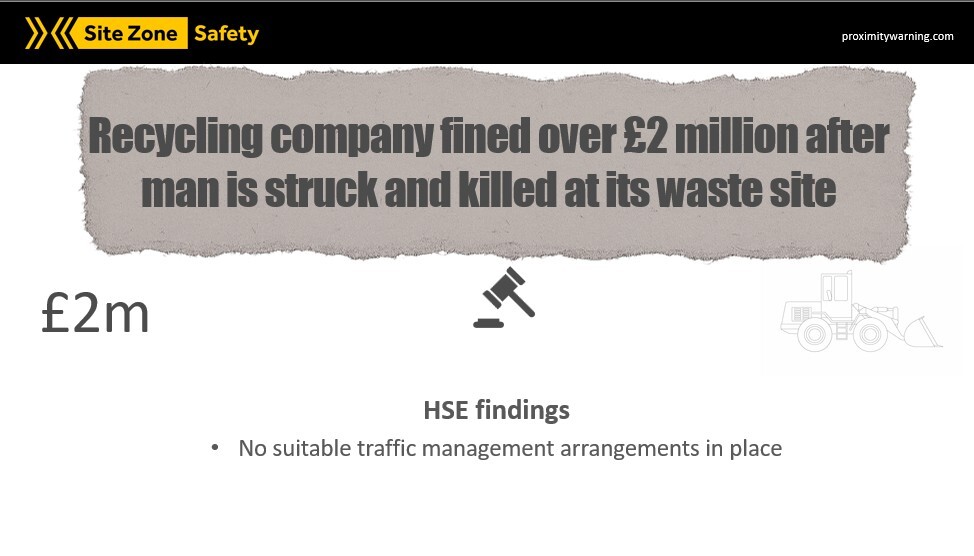
Let’s take a case that got a lot of headlines due to the size of the fine. A recycling company was fined £2m after an agency worker was struck and killed by a loading shovel at its waste site. The HSE said the death could have been entirely avoided if they had provided an alternative traffic route for pedestrians at its site.
The legal test used in investigations
When the HSE investigates a serious accident, two legal concepts appear repeatedly. They form the basis of how courts assess whether an employer met their duty of care.
Foreseeable risk
A foreseeable risk is a hazard that a competent employer should reasonably predict could cause harm.
Reasonably practicable
Employers must take all feasible measures to reduce risk unless the cost, time, or effort required would be grossly disproportionate to the level of risk.
These ideas underpin much of UK health and safety law, particularly the Health and Safety at Work etc. Act 1974. The law doesn’t demand the elimination of all risk; it requires organisations to manage risk to a level that is acceptable and proportionate.
In practice, this means courts examine what the employer knew what guidance existed, and whether sensible precautions were implemented.
What effective control actually looks like
Again, this not new or unknown. Detailed practical guidance already exists for organisations managing vehicle movement on site.
Documents such as Workplace Transport Safety: An HSE Guide (HSG136) outline the basic design principles that reduce risk. Industry guidance such as Safe Traffic Management Guidance for Waste and Recycling Sites (WASTE 09) from the WISH Forum also provides more specific examples for the sector.
Across most workplaces, effective traffic management tends to focus on a small number of actions:
-
Separating pedestrians and vehicles wherever possible
-
Designing clear traffic routes
-
Reducing or controlling reversing manoeuvres
-
Setting clear site rules and supervision arrangements
-
Providing training and consistent communication
These measures are practical rather than theoretical. When the’re embedded in day-to-day operations, they significantly reduce the likelihood of serious incidents.
Why this matters after an incident
When a workplace transport accident occurs, investigators don’t just look at the moment of impact. They look backwards at how the site was organised and whether the risks could have been addressed earlier. If you take a recent case as an example, although not a workplace transport case, it has an important takeaway.
A major builders merchant was fined £2.2 million after worker killed in conveyor crush. When the HSE investigated the incident and reviewed CCTV footage, they discovered that staff had previously accessed the danger zone 19 times and the only control measure put in place was signs and stickers. Therefore, this hazard was predictable and the control measures put in place did not go far enough.
In that sense, workplace prosecutions often hinge less on the accident itself and more on what happened before it.
This article is taken form a recent webinar held by SiteZone on Plant Pedestrian Safety in Waste & Recycling: What Good Really Looks Like.
You can watch the full webinar here.