

Contents
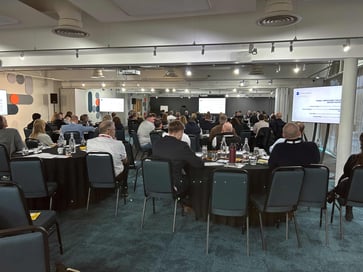
This year we sponsored the Let’s Recycle MRF Conference for the first time. As a company that partners with MRFs across the UK - including three of the six largest facilities - it was a good opportunity for us to learn more about the current state of the market and the many changes that are coming their way.
Many of you are faced with implementing process changes at your sites, dealing with increasing demands, and shifting operational requirements. MRFs are already busy environments – and these pressures bring additional challenges when it comes to keeping people safe around moving plant.
 We're not going to repeat the discussions or insights from the conference. Instead, we want to share our own experience and advice on managing the risk of pedestrian collisions, drawing on our work supporting 20+ MRFs across the UK.
What are the biggest pedestrian safety risks in a Material Recovery Facility?
MRFs are busy, constantly changing environments where pedestrians, forklifts, loading shovels, HGVs and other mobile plant often operate in close proximity.
Blind spots, reversing vehicles, restricted visibility and shared access routes can all increase the risk of collisions. As facilities adapt to changing market demands such as DRS and Simpler Recycling, increased throughput and changing processes, these risks can become even more challenging to manage.
The starting point should always be understanding where people and vehicles interact, identifying high-risk areas and assessing whether existing pedestrian segregation is adequate.
How can MRF operators prevent collisions between pedestrians and moving plant?
Of course, the most effective approach is to minimise the interaction between pedestrians and moving vehicles in the first place.
Physical segregation should be prioritised wherever reasonably practicable, using appropriate pedestrian barriers and vehicle impact protection to create clearly defined, protected walkways.
But we know this isn’t possible in all areas of the site. So, operators should also consider:
- Separating pedestrian and vehicle access points.
- Introducing designated pedestrian crossing points.
- Reducing vehicle movements and reversing manoeuvres.
- Reviewing vehicle routes and operational layouts.
- Using pedestrian detection technology like SiteZone Proximity Warning Systems as an additional layer of protection.
The HSE is very clear that painted walkways and signage alone are not sufficient protection where there is a risk of vehicle impact. The right combination of controls will depend on your site's individual risk assessment.
How do you know if your existing pedestrian safety measures are sufficient?
But even when you have pedestrian walkways and safety barriers in place doesn't necessarily mean pedestrians are adequately protected.
MRF operators should regularly review their site layouts (particularly if they have changed recently), vehicle movements, and existing protection measures to identify potential gaps.
Consider whether:
- Barriers are suitable for the types of vehicles operating nearby.
- Pedestrian routes remain protected during busy operational periods.
- Pedestrians are using the designated routes (this has been picked up recently in HSE prosecutions)
- High-risk crossing points are adequately controlled.
- Changes to plant, processes or site layouts have introduced new risks.
- Near misses and previous incidents are being used to improve safety.
Speaking to employees and reviewing how people actually move around the site can also reveal risks that might not be obvious from a site plan. This is a very important point. Your staff are working in it every day and will know where the highest risk points. Involve them – it’s a two-way conversation.
If you want an independent review of your plant pedestrian safety, request a free site survey.