If there’s something we’ve learnt from 15 years of helping customers, it’s that technology alone doesn’t solve your safety challenges. That’s why I refer to Maslow’s Hammer. You may know the name Maslow as the originator of the Hierarchy of Needs. He also made this well-known observation:
“If the only tool you have is a hammer, it is tempting to treat everything as if it were a nail.”
Why am I telling you this?
It’s because our most successful implementations don’t start with technology.
They start with assessing your site, completing your traffic plans, and having documented policies on plant pedestrian site rules. Then you know where your greatest risks are and what engineering controls you may need to mitigate these risks.
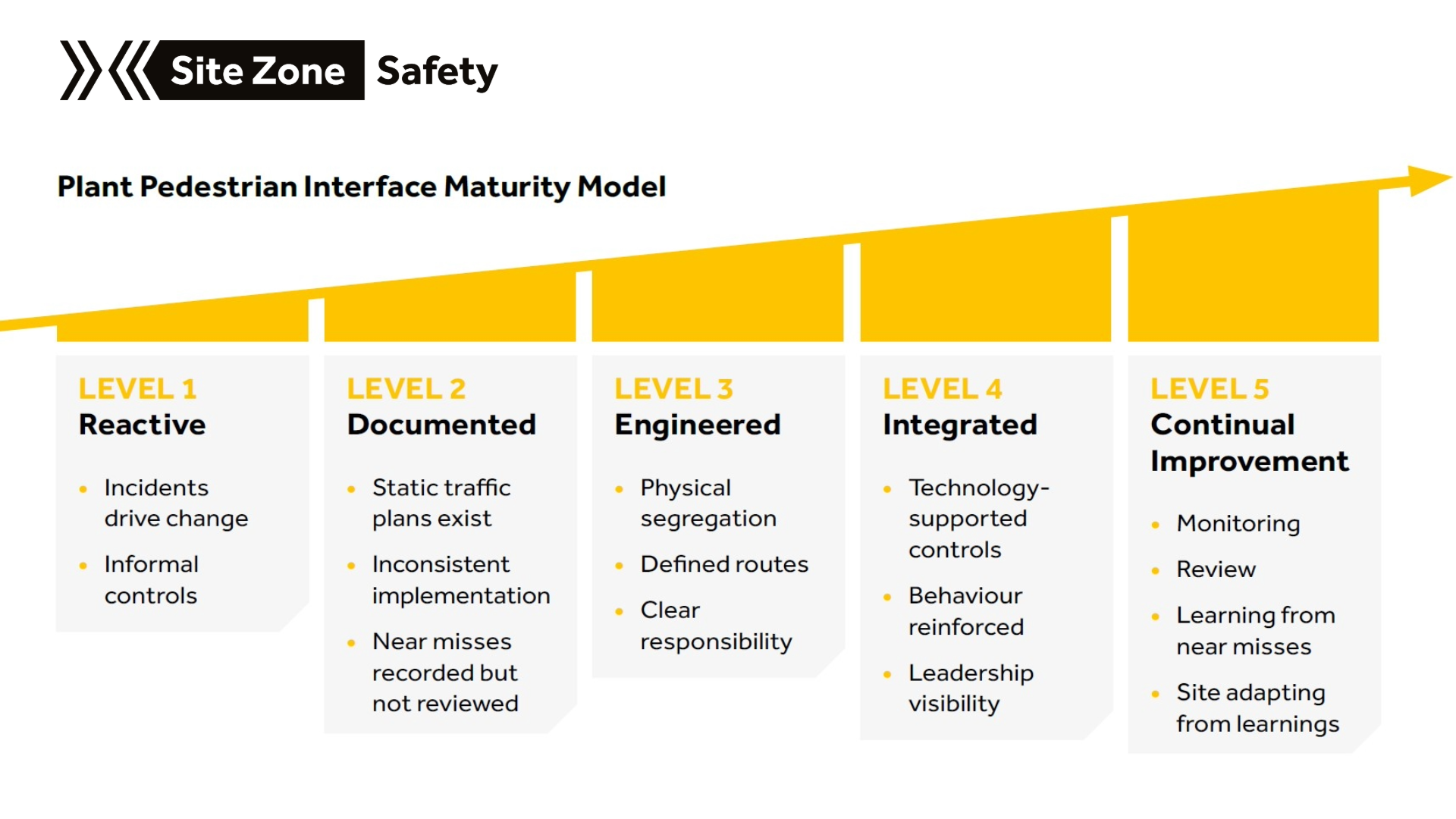
This is how we developed the Plant Pedestrian Interface (PPI) Maturity Model, going from Reactive at the bottom to Continuous Improvement at the top.
So, what are the stages?
LEVEL 1 - Reactive
This is often the first step. You’ve had a HSE visit or a near miss and need to act.
You’ve been relying on people ‘being careful’ up until now. Thankfully we’re now seeing less companies at this stage.
LEVEL 2 - Documented
You’ve done your paperwork, written a traffic plan, risk assessment, and trained people. But you haven’t reviewed this paperwork in years, it’s sat in someone’s draw and people on site don’t live and breathe the rules.
You’ve got a way of reporting near misses, but no one acts on what’s reported. This is something the HSE will use in prosecutions.
LEVEL 3 - Engineered
Think of the first three steps of your hierarchy of control (eliminate, substitute and engineering controls).
At this stage you’re starting to change your operation after reviewing your documentation.
You’ve got segregated walkways and working areas (such as baler areas) where possible. Your pedestrian and traffic routes are clearly marked, and vehicle flow is managed.
It’s a whole site approach, built with the plant pedestrian interface in mind.
And this is where technology such as the SiteZone Proximity Warning System comes into play. You know what risks you need to manage and implement the right technology to help you.
LEVEL 4 - Integrated
At this stage you’ve gone from individual components to a coherent working PPI system.
This could be multiple technologies working together. For example, Proximity warning technology on the vehicles that also activates signs. SiteZone Tags that control your access.
It’s integrated into your working day; supervisors know what to look for and leadership give it a priority.
But you're not just choosing tech for techs sake. Because of the steps you've made to this point (documented and engineered), tech becomes a part of your PPI system.
LEVEL 5 - Continual Improvement
The final step on the PPI maturity level is where the feedback loop comes in.
You regularly review data and act on it. Near miss analysis informs changes on site.
The whole team is engaged as you monitor, review, learn and adapt your site and operations. This is where culture comes in. Your staff aren’t afraid to speak up if something is wrong.
Where do you think you sit on the PPI Maturity Model?
Want to see who's at the top of the maturity model?
-
Look at the Enva Tilbury Case Study as an example of how a site can integrate multiple control measures to create a comprehensive Plant Pedestrian Interface management system.
-
FCC Environment is an example of a company who has built plant pedestrian safety in their culture and way or working. 12 years working in partnership with SiteZone they've had 0 plant pedestrian incidents.